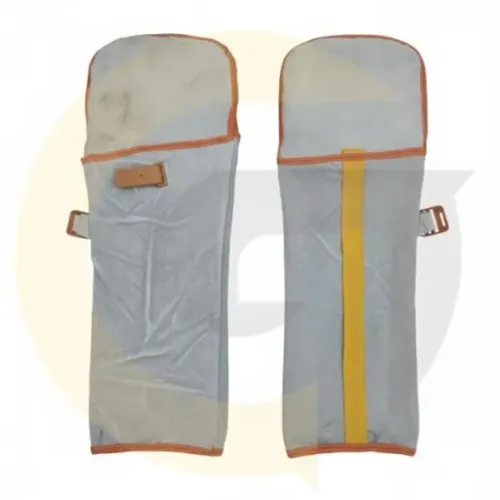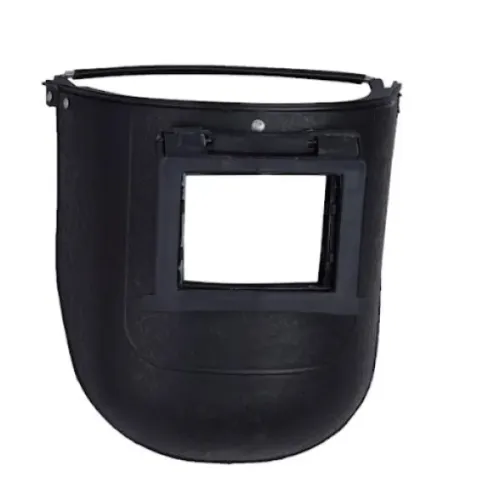
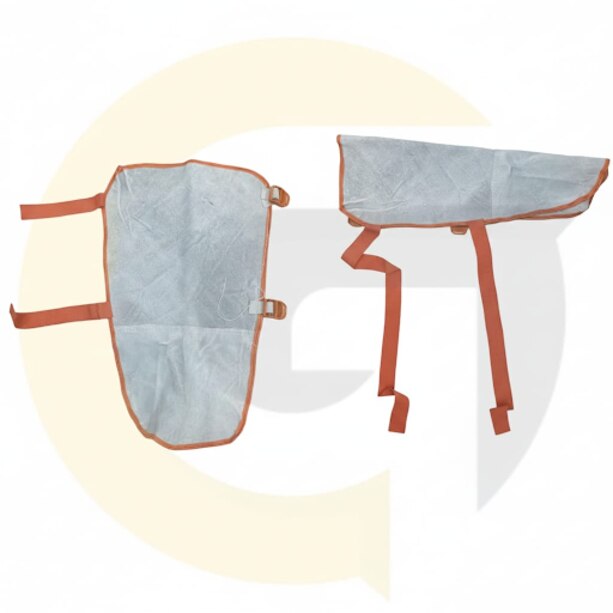
A leather leg guard is useful only when its coverage, materials, fastening, and documented performance match the hot-work hazard in front of you. By the end, you will be able to match leg protection to welding and cutting tasks, check whether a design will work with your boots and trousers, and identify the evidence and care instructions a responsible dealer should provide.
Key takeaways
- Use wraparound guards for welding, gouging, cutting, and foundry work.
- Choose full-grain leather with secure closures and coverage above the boot.
- Ask for welding-specific test evidence, not only a heat-resistant label.
- Replace guards with burn-through, stiffened leather, failed stitching, or damaged fasteners.
Which hot-work tasks justify a leather leg guard?
Stick arc welding, MIG welding, gouging, gas cutting, and foundry work often justify a wraparound leather leg guard because sparks and hot particles can enter at a trouser cuff or boot top.
That brief exposure differs from sustained radiant heat, direct contact with hot metal, molten-metal pooling, or flame exposure, which require additional or different protection.
| Task | Lower-leg exposure | Leg-guard decision |
|---|---|---|
| Stick arc welding | Frequent sparks, slag, and spatter | Use wraparound coverage; this is part of arc welding PPE |
| MIG welding | Spatter can fall into cuffs and boot openings | Use wraparound MIG welding protection for overhead or positional work |
| TIG welding | Lower spatter, but heat varies with amperage and position | Review the task before selecting TIG welding PPE |
| Gas cutting | Hot slag, flame, and cut-off pieces | Use coverage where slag can fall onto boots |
| Gouging | Heavy sparks, slag, noise, and radiant heat | Use substantial wraparound coverage |
| Brazing | Heat and filler-metal droplets vary by joint and method | Assess the torch, alloy, duration, and position |
| Grinding | Brief hot particles, with possible wheel fragments | Use it for spark entry only; add task-specific eye and face protection |
| Foundry work | Radiant heat, hot surfaces, and molten-metal splash | Use purpose-designed foundry protection, not a basic gaiter |
A leather leg guard for welding protects only the lower leg and boot opening. It protects neither the torso, arms, hands, eyes, face, head, nor lungs, so pair it with welding clothing, gloves, safety footwear, eye and face protection, ventilation, fire controls, and a fire watch when required.
What fit and construction details determine whether it works?
Welding leg guard fit depends on coverage and closure, not leather thickness alone. Check the leather gaiter dimensions from the lower edge to the top, the protected area, wraparound width, thickness, total weight, and overlap above the safety-boot opening.
1. Wear the same trousers, apron, and boots used on the job. Fasten the guard around the calf without constricting circulation, then kneel: the top edge must cover the exposed knee and trouser area without cutting into the leg.
2. Check the wraparound leg protection from front to back. The closure must meet securely, with no spark-catching gap, loose flap, exposed strap end, or open seam facing the work. Record the number and position of straps, and reject hardware that lands behind the knee or over the ankle joint.
3. Walk, climb, squat, and flex the foot. The lower edge must overlap the boot top for boot-top protection while leaving the ankle, laces, metatarsal area, and sole clear enough for normal movement.
4. Compare weight and stiffness with the task duration. Thick, rigid leather can improve spatter coverage but retain more heat, burden the legs, and restrict kneeling or climbing during continuous work.
Before ordering, request a size chart, photographs of the guard being worn, leather thickness and weight, strap and closure details, and compatibility guidance for trousers, aprons, metatarsal boots, and lace-up safety boots. A guard that fits only over bare clothing is not a usable specification.
What evidence separates welding protection from a generic heat-resistant claim?
Trust a named standard and its scope, not “heat resistant.” ISO 11611 Class 1 covers less hazardous welding techniques with lower spatter and radiant-heat levels; ISO 11611 Class 2 covers more hazardous techniques with higher levels. The testing addresses garment performance, including limited flame spread and resistance to heat and molten-metal effects.
| Claim | Evidence it supports | Do not infer |
|---|---|---|
| Welding spatter protection | ISO 11611 classification for the complete leg-guard configuration | Flash-fire, molten-metal immersion, or arc-flash protection |
| Flash-fire protection | A separate flash-fire test and marking | ISO 11611 compliance alone |
| Molten-metal protection | Test evidence for the stated molten-metal hazard | Protection against every molten-metal exposure |
| Electrical arc protection | ASTM F1506 arc-rated PPE labeling and an ASTM F1959/F1959M result showing ATPV or EBT where applicable | An arc rating because the guard is leather |
Request conformity information for the actual design, leather, thread, closures, and configuration. A certificate for another garment does not validate the leg guard you will issue.
- The exact ISO 11611 class and the tested garment or component configuration
- Test reports or a declaration identifying the manufacturer, model, and material construction
- Separate markings for flash fire, molten-metal immersion, or electrical arc hazards
- ASTM F1506 arc-rated PPE documentation when arc-flash exposure exists
- The ASTM F1959/F1959M arc-performance result, including ATPV or EBT where applicable
Ordinary leather is not arc-flash PPE. Welding-spatter evidence also does not certify the wearer’s boots, gloves, face, eyes, head, or respiratory protection.
How should you inspect, clean, store, and replace the guard?
Before every shift, perform a welding PPE inspection: leather can burn, stiffen, shrink, crack, and lose strength after repeated heat exposure. Check the guard before relying on it.
1. Examine the full surface for burn-through, brittle or shrunken leather, cracks, stiffened areas, split seams, loose or melted thread, damaged straps, failed closures, and embedded metal particles. Test each closure and look for a gap or loose flap that could catch spatter.
2. Clean the guard according to the manufacturer’s instructions. Keep oil, grease, solvents, and other chemicals away; contamination can increase flammability or degrade leather, thread, and closures. Do not apply an unapproved solvent, coating, or conditioner.
3. Treat molten spatter damage as a stop-work issue. Remove the guard and inspect it after spatter lands; take it out of service if metal has penetrated or fused to the leather, or if the heat has cracked the leather or damaged stitching. Do not scrape aggressively or continue working in it.
4. Air-dry wet leather in a dry, ventilated area away from direct heat. Never place it on a heater, beside a flame, or against hot equipment, because rapid heating can shrink and harden it.
5. Store the clean, dry guard away from chemicals, sunlight, moisture, and sharp tools. Apply the manufacturer’s PPE replacement criteria: replace it after a failed inspection, serious heat or chemical exposure, or damage whose cause and extent you cannot trace. Follow the maker’s replacement instructions for service-life limits.
What should a responsible dealer provide with the leg guard?
An industrial PPE dealer should not label an ordinary leather gaiter as universal welding protection. OSHA requires employers to base hazard assessment PPE on documented workplace hazards, select clothing that minimizes ignition, burning, trapped hot sparks, and electric-shock hazards, ensure fit, and maintain PPE in sanitary, reliable condition.
| Information to request | Why it matters | Red flag |
|---|---|---|
| Task suitability and coverage limits | Shows whether the guard suits arc welding, cutting, gouging, or another hot-work task and covers only the lower leg and boot opening | “All-purpose” protection with no exposure limits |
| Dimensions, leather thickness, thread, weight, and size range | Lets you balance spatter coverage against heat retention, bulk, and movement | No measurements or material details |
| Fastening method, straps, and closures | Confirms that it stays closed around the calf and overlaps the boot without a spark-catching gap | Loose flap, failing buckle, or unclear boot compatibility |
| ISO 11611 classification | Class 1 and Class 2 indicate tested welding-clothing performance at different hazard levels | “Heat resistant” with no conformity claim or test information |
| Care and replacement instructions | Gives supervisors a basis for inspection and withdrawal after damage | No cleaning, storage, or discard criteria |
A welding safety equipment supplier should help you compare the guard with an apron, sleeves, gloves, boots, and face protection. It protects none of the torso, arms, hands, eyes, face, head, or lungs.
Goyals Industrial Hub can make hot-work PPE selection more useful by pairing each product with this decision information, so buyers choose coverage without hiding performance limits.
Related product
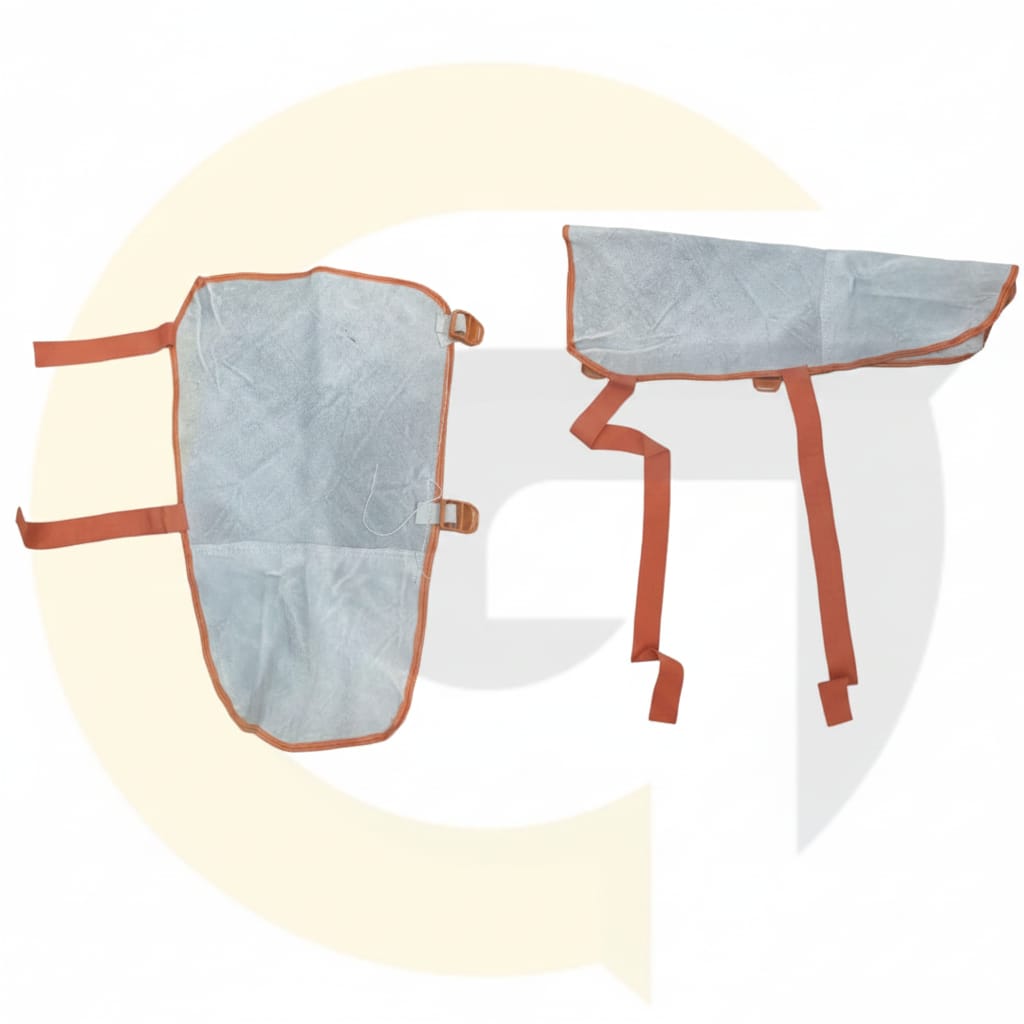 | Safety Leather Welding Leg Guards – Heat & Spark Resistant Protection Ensure maximum lower-body safety with these heavy-duty leather welding leg guards. View product → |
Frequently asked questions
Which hot-work tasks justify a leather leg guard?
Stick arc welding, MIG welding, gouging, gas cutting, and foundry work can send sparks and hot particles into trouser cuffs or boot tops. A wraparound leather guard adds coverage where ordinary trousers leave a gap.
What fit and construction details determine whether a leg guard works?
Check that the guard covers the front and sides of the lower leg, overlaps the boot top, closes securely, and stays in place while you walk, kneel, and weld. Look for durable leather, protected seams, and fasteners that do not expose skin or snag clothing.
What evidence separates welding protection from a generic heat-resistant claim?
Ask for the product specification, intended-use statement, leather type and thickness, seam and closure details, and any test report or standard reference covering welding sparks, molten metal, or radiant heat. A phrase such as heat resistant without test conditions does not establish welding protection.
How should you inspect, clean, store, and replace a leather leg guard?
Inspect it before each use for burn-through, cracks, hardened or brittle leather, open stitching, damaged closures, and contamination. Brush off dry debris, follow the manufacturer’s cleaning instructions, store it dry away from sunlight and chemicals, and replace it when damage creates a hole, weak seam, or unreliable closure.
What should a responsible dealer provide with the leg guard?
A responsible dealer should provide clear use limitations, sizing and fitting instructions, care guidance, inspection points, material details, traceability information, and any available test evidence. The dealer should also explain which welding and hot-work tasks the guard does not cover.