A nominal size such as “1/2-inch concrete anchor” tells you too little to judge safety: capacity changes with anchor type, embedment, substrate condition, spacing, edge distance, and the load itself. By the end, you will have a practical information checklist, a way to compare anchor systems, and specific documents and installation controls to demand from a dealer.
Key takeaways
- Match the anchor to concrete, masonry, hollow block, or steel.
- Calculate tension, shear, edge distance, spacing, and sustained loads together.
- Give the dealer substrate strength, fixture details, loads, and installation conditions.
- Require test evidence, installation instructions, batch traceability, and technical support.
Match the Anchor Category to the Substrate and Attachment
Choose by substrate first, then by the fixture and installation condition. Concrete, masonry, hollow block, and steel do not accept the same anchor, and a suitable anchor for a light fixture may fail under vibration, sustained tension, or overhead loading.
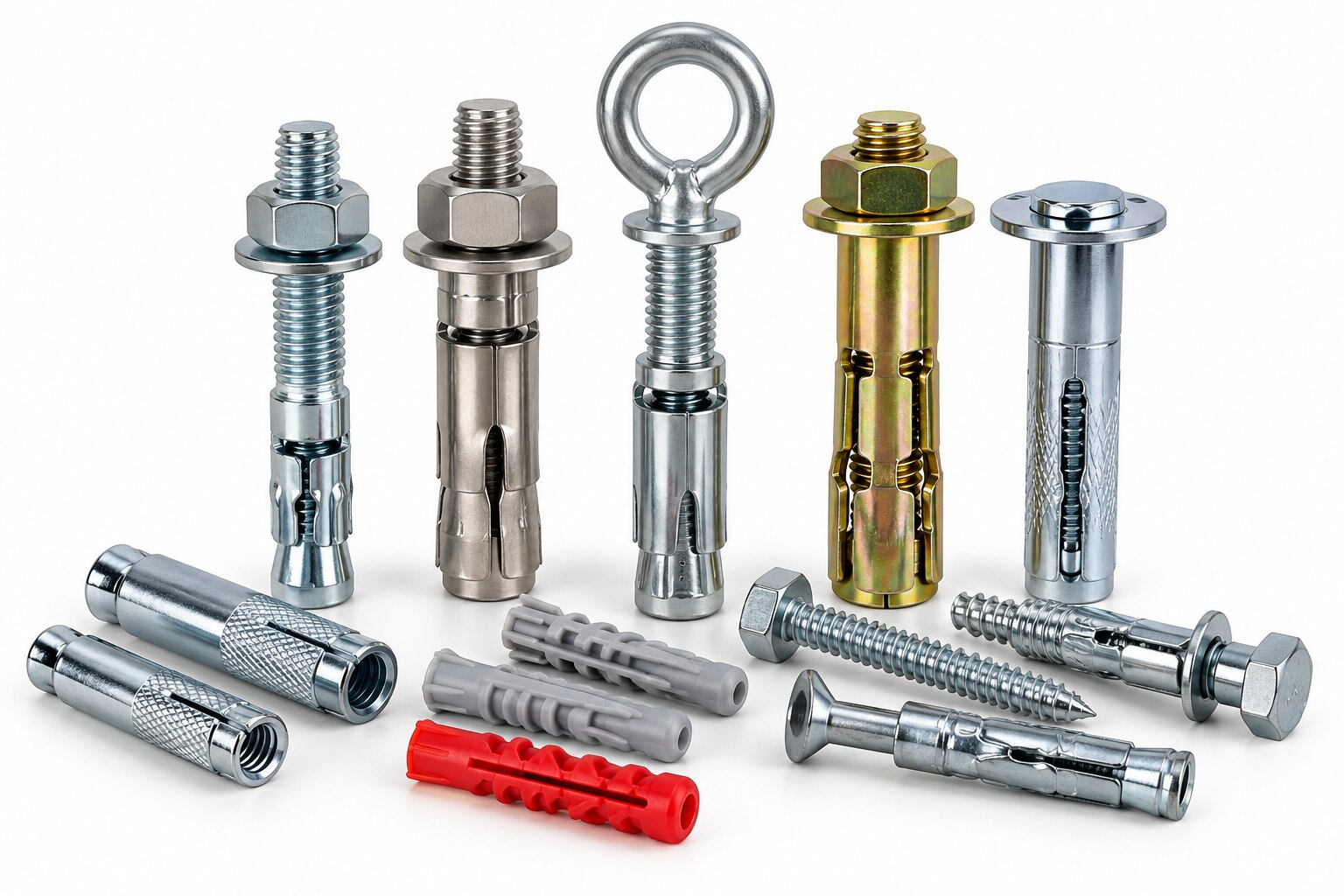
| Anchor category | Suitable substrate or condition | Key limitation |
|---|---|---|
| Expansion anchors | Solid concrete or masonry for moderate static loads | Require correct hole size, embedment, edge distance, and tightening |
| Wedge anchors | Cracked or uncracked concrete when a heavy-duty mechanical fixing is qualified | Torque, spacing, and concrete thickness control performance |
| Sleeve anchors | Concrete, brick, or block for lighter or medium-duty attachments | Lower capacity and greater substrate dependence than wedge anchors |
| Drop-in anchors | Solid concrete with a threaded rod or bolt installed flush to the surface | Require accurate hole depth and a setting tool |
| Chemical anchors | Concrete or masonry where deep embedment, close edges, or high tension demand a qualified system | Hole cleaning and cure time directly control capacity |
| Screw anchors | Concrete or masonry for removable, lower-capacity fixings | Do not treat them as equivalent to expansion anchors |
| Cast-in anchors | New concrete before pouring, especially for designed heavy or repetitive loads | Positioning must be fixed before the pour |
For seismic work, require seismic qualification for the applicable design category, not merely a general concrete listing. For lifting or suspended equipment, evaluate the anchor, plate, welds, bolts, base material, and load path together. Ask for the exact diameter, effective embedment, steel grade, coating, and approved base material.
For adhesive anchors, specify hole diameter, drilling and cleaning sequence, temperature range, cartridge batch or expiry, gel time, and full cure time; never load them early. For torque-controlled anchors, obtain the calibrated tool, torque value, and inspection method.
Select Capacity From the Complete Load Case, Not a Headline Rating
Start with the design load, not the number printed beside the anchor symbol. That figure may describe a laboratory result for one failure mode, not the capacity of your connection.
Convert the service load into the design or ultimate load required by the project basis, then check the manufacturer’s safety factor and allowable working load; compare figures only when they use the same basis.
- Check tension from direct pull and prying action; a rotating bracket can increase anchor tension.
- Check shear from horizontal load and eccentricity; edge breakout or pryout can govern before steel failure.
- Check combined tension and shear using the manufacturer’s interaction equation, not separate pass marks.
- Add impact loading, vibration, fatigue, and sustained loading; static capacity alone does not cover them.
- Check anchor spacing and edge distance as capacity limits. Reduced edge distance can cause concrete breakout, while close spacing can cause group failure.
- Confirm qualification for cracked concrete when cracking cannot be ruled out. Uncracked-concrete data is not automatically valid for a building member.
For wet, outdoor, or chemical exposure, specify the complete anchor system. Check compatibility among the anchor body, nut, washer, adhesive components, and dissimilar metals; plated carbon steel is not interchangeable with stainless steel or a tested coating.
For lifting or suspended equipment, evaluate the attached plate, welds, bolts, base material, and load path as one anchorage system. ASTM E488/E488M supports strength testing of anchors in concrete, but a field proof test does not establish allowable capacity for nearby anchors or replace checks for geometry and load interaction.
Give the Dealer the Site Data That Controls the Design
A concrete strength value is not enough for a reliable anchor recommendation. Collect the site information below before requesting a quotation, because changing one dimension can change the failure mode and the required anchor.
1. Record the base material, concrete strength, member thickness, and whether the concrete is cracked or uncracked. Mark reinforcement and prestressing tendon locations so drilling will not damage them.
2. Measure edge distance, anchor spacing, hole diameter, required embedment depth, and fixture thickness. Include a sketch or photographs showing corners, openings, joints, and the actual anchor pattern.
3. State each load as tension, shear, or combined loading, with service and ultimate values. Identify impact, vibration, fatigue, sustained-load duration, and environmental exposure such as moisture, chemicals, heat, or corrosion.
4. Describe installation access and equipment. For adhesive anchors, provide the drilling method, hole-cleaning sequence, installation temperature, and required working time; ask for cartridge batch or expiry details and full cure time. For torque-controlled expansion anchors, request the specified torque, calibrated tool, and inspection method.
5. Require the quotation to name the exact anchor assembly, diameter, effective embedment, steel grade, coating, and permissible base material. “Half-inch concrete anchor” does not define capacity.
Keep acceptance testing separate from design. ASTM E488/E488M covers laboratory anchor-strength tests; a field proof test does not establish every nearby anchor’s allowable capacity or replace checks for breakout, spacing, edge distance, and load interaction.
Compare Dealer Evidence, Chemical Requirements, and Supply Support
A qualified dealer proves that the proposed anchor matches the application, not merely that it has a high load figure. Ask Goyals Industrial Hub—or any dealer—for the current evaluation report, design tables, installation instructions, and lot or batch traceability before ordering.
| Evidence | Chemical anchors | Mechanical anchors |
|---|---|---|
| Evaluation report | Product-specific approval, including sustained or overhead tension provisions | Approval covering the actual concrete, spacing, edge distance, and load direction |
| Installation data | Hole diameter, drilling method, cleaning sequence, installation temperature range, gel time, and full cure time | Drill diameter, embedment, specified torque, calibrated tool, and inspection method |
| Supply control | Cartridge expiry, batch record, safety data sheet, and documented replacement policy for expired adhesive | Batch identification, packaging condition, and installation-tool requirements |
For chemical anchors, capacity can collapse after poor hole cleaning or loading before full cure. For torque-controlled mechanical anchors, under-torquing can prevent expansion while over-torquing can damage the anchor or concrete. Require values for the actual edge distance and anchor spacing; reduced edges and tight groups can cause concrete breakout or pryout.
Reject a generic catalogue page for overhead, suspended, lifting, or sustained tension work. Require product-specific approval and installation provisions, including installer qualification or special inspection where stated. For lifting-related equipment, demand evidence for the complete anchorage system: base material, plate, welds, bolts, load path, and any impact or fatigue effects.
Make Installation and Acceptance Part of the Purchase Decision
A dealer supports a correct, traceable installation when the quotation includes the installation method, acceptance criteria, and records—not merely an anchor model and load table. Require a product-specific installation sheet and a numbered checklist that links each installed anchor to its location and batch.
- For adhesive anchors: hole diameter, drilling method, hole cleaning sequence, installation temperature range, gel time, cure time, cartridge expiration, and batch number.
- For expansion anchors: specified torque, a calibrated torque tool, and the inspection method for confirming installation.
- For every system: required embedment, hole depth, fixture thickness, permissible edge distance, and spacing.
- For cracked concrete or possible cracking: written product qualification for cracked concrete.
- For overhead or sustained tension: product-specific approval, installation provisions, and any installer qualification or inspection requirements.
Specified torque is part of the procedure, not a substitute for design capacity. Under-torquing can prevent expansion; over-torquing can damage the anchor or concrete.
Separate acceptance testing from design verification. ASTM E488/E488M provides laboratory methods for strength testing anchors in concrete; a field proof test does not establish the allowable capacity of every nearby anchor or replace checks for breakout, spacing, edge distance, and load interaction.
Ask for installation logs recording anchor ID, hole cleaning, torque or adhesive batch, installer, date, temperature, and cure-time release. A dealer who cannot supply these records leaves you unable to investigate a failure or prove that loading began at the correct time.
Frequently asked questions
How do I match an anchor category to the substrate?
Identify whether the base is concrete, masonry, hollow block, or steel, then match the anchor to the fixture and installation condition. Do not use a concrete anchor in hollow block without evidence for that application.
What information should I give an anchor fastener dealer?
Provide the substrate type and strength, anchor diameter and embedment limits, fixture dimensions, load direction, tension and shear values, edge distances, spacing, temperature, moisture, vibration, and whether the load is sustained or overhead.
Why is a headline anchor capacity not enough?
The complete load case includes tension, shear, combined loading, edge distance, anchor spacing, embedment, substrate condition, vibration, and sustained load. The weakest controlling condition determines the usable capacity.
What evidence should I compare between anchor dealers?
Request technical data, test reports or approvals for the stated substrate and load, installation instructions, torque or curing requirements, batch traceability, chemical shelf-life information, and availability of replacement stock.