A leather apron purchase is a protection decision, not a comparison of leather colour and advertised toughness. You need to match the garment’s construction, coverage, fit, documentation, and after-sales support to the hot-work hazards your team actually faces, then verify the sample before accepting a bulk order.
Key takeaways
- Ask about process, amperage, fuel gas, position, and hot-material hazards.
- Check split-grain or full-grain leather, reinforced seams, rivets, and secure closures.
- Match apron length, sleeve coverage, fit, and heat resistance to the task.
- Require material specifications, test reports, batch traceability, and replacement terms.
What should you ask a leather apron dealer before ordering?
Ask for proof of fit, exposure suitability, and supply continuity—not just the lowest quotation. A capable leather apron dealer will ask whether you weld, cut, gouge, or grind; your amperage or fuel-gas setup; the working position; and whether hot material can fall onto combustible surfaces.
Before ordering, ask:
- Which leather type, thickness, coverage pattern, and standard apply to this model?
- What size range is in stock, and can you provide the waist range, apron length, and chest coverage?
- What is the stock depth, and how many units can you supply for the required order quantity?
- What is the dispatch date, delivery coverage, and lead time for repeat orders?
- Which cleaning, drying, storage, and inspection instructions come with the garment?
| Dealer answer | Why it matters | Warning sign |
|---|---|---|
| Stock depth and replenishment date | Prevents production delays and mismatched replacement aprons | One sample shown as “available” |
| Size availability and fit data | Helps the apron sit over a jacket without restricting movement | Single nominal size |
| Replacement policy | Clarifies defective fasteners, damaged stitching, and size exchanges | Verbal promises only |
| Model-specific documents | Confirms the garment claim rather than relying on “welding-grade leather” | Only a generic material statement |
| Care and after-sales support | Incorrect washing or solvent cleaning can harden, shrink, or weaken leather | No written instructions |
For cutting, plasma work, or gouging, reject a dealer who recommends an apron without discussing streams of hot particles, slag, flame, and radiant heat. Also confirm that ordinary leather is not being presented as arc-rated electrical PPE.
Which construction details determine whether an apron will hold up?
A durable apron starts with leather that matches the exposure, not the heaviest-looking sample. Check leather thickness across the whole panel; thin spots, loose fibres, pinholes, and uneven edges reveal weak coverage before the first shift.
| Construction choice | Inspect | Trade-off |
|---|---|---|
| Split leather | Consistent surface, sealed edges, and no flaking fibres | Usually costs less, but its rougher surface can wear faster |
| Grain leather | Tight, intact outer surface without cracks or excessive finishing | Smoother and more abrasion-resistant, but often costs more |
| Stitched stress points | Dense, even thread at neck, waist, bib corners, and side ties | Flexible under movement; failed stitching can open suddenly |
| Riveted stress points | Covered or recessed rivets that do not rub your clothing or skin | Strong reinforcement; exposed metal can heat up or snag |
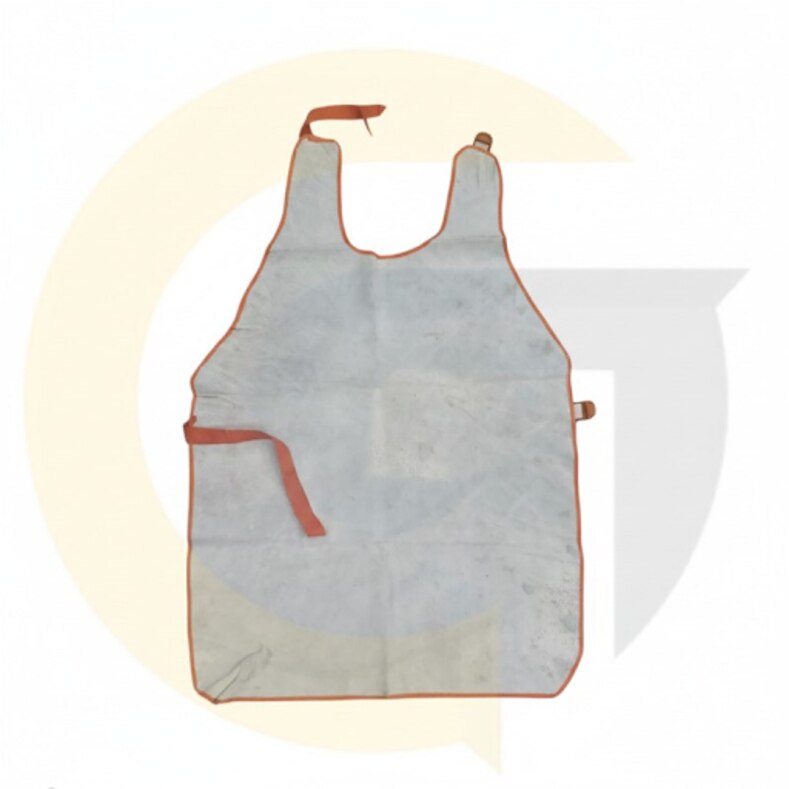
Look for stitched stress points at every load-bearing attachment, with thread that resists heat and abrasion. Tug each strap and buckle by hand. Adjustable neck and waist fasteners should hold their setting, while ties need enough length to secure the apron over a jacket without hanging into moving equipment.
Coverage should protect the chest, abdomen, lap, and upper legs in your working position. For cutting, gouging, or overhead work, choose a longer front and coverage that limits hot-particle entry at the sides and neck; ordinary welding-spatter coverage is not enough.
Remove an apron from service after burn-through, holes, open seams, severe charring, brittle or glassy leather, permanent contamination, or a strap that no longer holds. Ask for leather-specific cleaning, drying, and storage instructions, because the wrong wash or solvent can shrink and harden it.
How should the apron match the worker, process, and exposure?
Match the apron to the worker’s measurements, the process’s spatter pattern, and the exposure gaps that remain. An apron provides partial-body coverage, so it cannot replace protection for the sides, shoulders, arms, legs, or footwear.
1. Measure the operator over the clothing and PPE worn during the job. Check the apron fit, waist range, length, chest coverage, shoulder clearance, and whether the neck strap leaves movement without exposing the upper chest. A short apron can leave the thighs unprotected; an oversized one can snag on fixtures.
2. Tell the dealer the exact process and working position: MIG, TIG, stick welding, grinding, oxy-fuel cutting, plasma cutting, or gouging. Include welding amperage, fuel-gas setup, cutting direction, work height, and whether hot particles land on a combustible surface.
3. Use the declared EN ISO 11611 class as a comparison point. Class 1 suits lower spatter and radiant-heat exposure; Class 2 addresses higher spatter and heat. TIG work may need less front protection than heavy stick welding, but select for the actual position and output.
4. Treat cutting and gouging as high-particle exposure, not ordinary welding. Streams of slag, flame, radiant heat, and hot fragments can require a jacket or coat, sleeves, trousers, gaiters, and protective footwear alongside the apron.
5. For overhead welding, choose full upper-body and leg protection rather than an apron alone. Reject any apron contaminated with oil, grease, solvent, or other combustible material; clean leather does not remove the need for complete hot-work PPE.
What standards and documents should you require from the dealer?
A dealer’s phrase “heat-resistant leather” proves nothing about garment-level protection. Before paying, require a model-specific conformity declaration or certificate, the manufacturer’s instructions, and a clear photograph of the sewn-in or printed marking.
1. Ask for the EN ISO 11611 reference, the declared Class 1 or Class 2 rating, garment model, manufacturer, size range, and production or batch identification. Class 1 suits lower spatter and radiant-heat exposure; Class 2 addresses higher exposure.
2. Check whether the marking includes A1, A2, or both. A1 covers surface-ignition testing and A2 covers edge-ignition testing; these flame-spread designations are separate from Class 1 and Class 2. A Class 2 apron is not automatically marked for both ignition modes.
3. Request the manufacturer’s EN ISO 13688 information for sizing, ergonomics, marking, and user instructions. “CE leather apron” without the applicable standard, class, manufacturer, and instructions is insufficient technical evidence.
4. Tell the Delhi or Delhi NCR dealer your process, welding current, fuel-gas setup, cutting position, and whether you work overhead or above combustible surfaces. Ask the dealer to record why the selected class and coverage suit that exposure.
Leather thickness, weight, “welding-grade leather,” and a raw-hide specification cannot replace these documents. Goyals Industrial Hub can be assessed on whether it supplies this model-level evidence rather than relying on a generic material description. If the dealer cannot identify the manufacturer or match the paperwork to the apron’s marking, reject the claim.
Related product
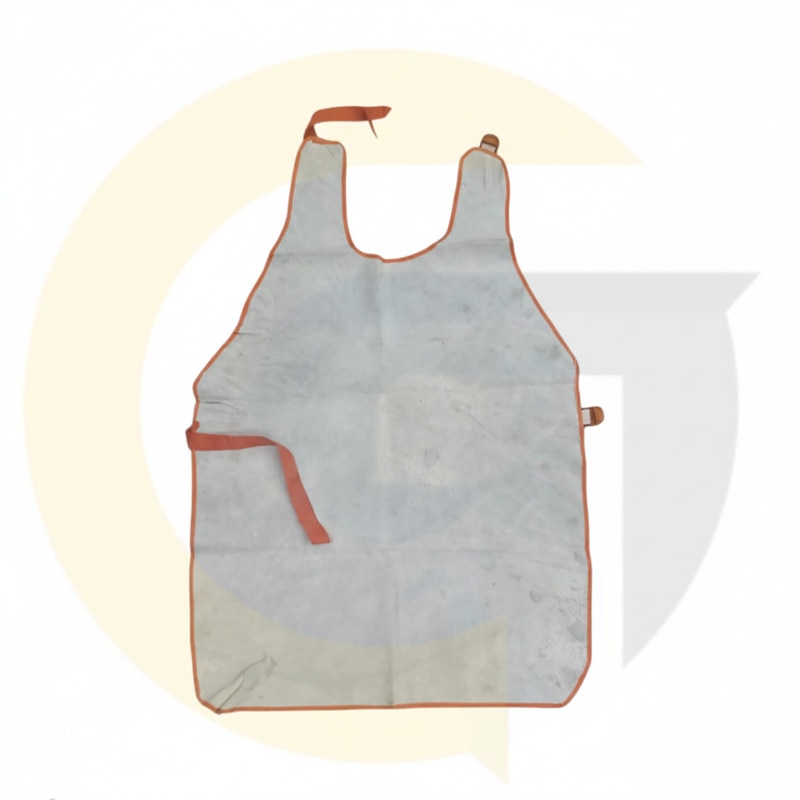 | Safety Heavy-Duty Leather Welding Apron – Heat & Spark Resistant Protective Gear Stay protected while you work with this heavy-duty leather welding apron, designed to shield you from sparks, spatter, and heat. View product → |
What will the apron cost you after delivery?
The purchase price is only the first charge. Add delivery, spare straps, cleaning time, storage space, and replacement stock; a cheap apron becomes expensive when one damaged unit stops a welder’s shift.
Budget for these after-delivery costs:
- Cleaning: Follow the dealer’s leather apron maintenance instructions. Do not machine-wash or solvent-clean leather unless the instructions permit it; the wrong treatment can shrink, harden, or weaken the hide.
- Storage: Hang aprons dry, away from welding sparks, direct heat, moisture, and chemicals. Folded or damp leather can develop permanent creases and concealed damage.
- Inspection: Include a PPE inspection before each shift. Remove an apron with burn-through, holes, open seams, severe charring, brittle or glassy leather, failed straps, loose fasteners, or contamination that will not come out.
- Replacement: Replace contaminated or damaged aprons rather than repairing over a weakened area. Oil contamination and grease are combustible hazards during hot work.
For multiple operators, adjustable neck and waist straps reduce size-related waste, but test them over jackets and gloves. Poor strap placement can snag, while exposed metal hardware can heat against the body.
Watch for heat buildup during long cutting or welding cycles; an apron that causes workers to loosen it or remove it is not delivering reliable protection. Keep enough correctly sized spares to cover cleaning, inspection failures, and sudden replacement, and assign each apron or record its user so damage does not pass unnoticed between shifts.
Frequently asked questions
What should you ask a leather apron dealer before ordering?
Tell the dealer whether you weld, cut, gouge, or grind; provide amperage or fuel-gas details, working position, and the risk of hot material reaching combustible surfaces. Ask for sizing, material thickness, construction details, delivery terms, and replacement support.
Which construction details determine whether a leather apron will hold up?
Check the leather type and thickness, full coverage, double-stitched seams, reinforced stress points, heat-resistant thread, secure straps, corrosion-resistant hardware, and protection around the chest, waist, and legs.
How should the apron match the worker, process, and exposure?
Choose coverage based on sparks, slag, radiant heat, sharp edges, and overhead work. The apron must fit without restricting movement, leave no exposed gap while bending, and work with gloves, safety footwear, and other PPE.
What standards and documents should you require from the dealer?
Request the leather specification, product data sheet, care instructions, batch or lot traceability, and test reports that identify the exact model tested. Check whether the documents cover the hazards and performance claims made for the apron.
What will the apron cost you after delivery?
Compare the quoted price with freight, taxes, minimum order quantities, size substitutions, inspection time, cleaning or care requirements, expected replacement frequency, and the cost of downtime if the dealer cannot replenish stock.